
Most of us spend hours each day looking at screens — laptops at work, phones between tasks, tablets in the evening. It has become so normal that we rarely stop to think about what that sustained position is doing to our bodies. But researchers and clinicians have increasingly drawn attention to a pattern of postural change now commonly referred to as "tech neck" — and the effects go well beyond a sore neck at the end of the day.
The weight of a forward head
In its neutral position, balanced directly above the shoulders, an adult head weighs roughly 4–5 kilograms. That load is managed comfortably by the cervical spine and its surrounding muscles when alignment is good. But as the head moves forward — as it does when we look down at a phone or hunch toward a screen — the effective load on the neck increases dramatically.
A 2014 study (1) by spinal surgeon Dr Kenneth Hansraj, calculated that tilting the head forward by just 15 degrees increases the load on the cervical spine (neck) to around 12 kilograms. At 45 degrees of forward tilt — a common angle when looking at a phone resting in your lap — that load rises to approximately 22 kilograms. Sustained over hours each day, this places extraordinary demand on the muscles, joints and discs of the neck and upper back.
Head position and approximate load on the cervical spine
Neutral (ears over shoulders) → 4–5 kg
15° forward tilt → ~12 kg
30° forward tilt → ~18 kg
45° forward tilt → ~22 kg
Source: Hansraj KK, Surgical Technology International, 20
It's not just about the neck
The consequences of sustained forward head posture extend well beyond local neck pain and muscle tension. Dr Hansraj’s research (1) also noted that spending several hours per day in poor posture can begin to alter the natural curvature of the cervical spine over time — a change that is far more difficult to address once it becomes established.
As Chiropractors, we have seen a shift over the past 10-20 years with more people losing the natural curve of the cervical spine and an increase in reversed curves which is a result of excessive time looking at handheld devices.
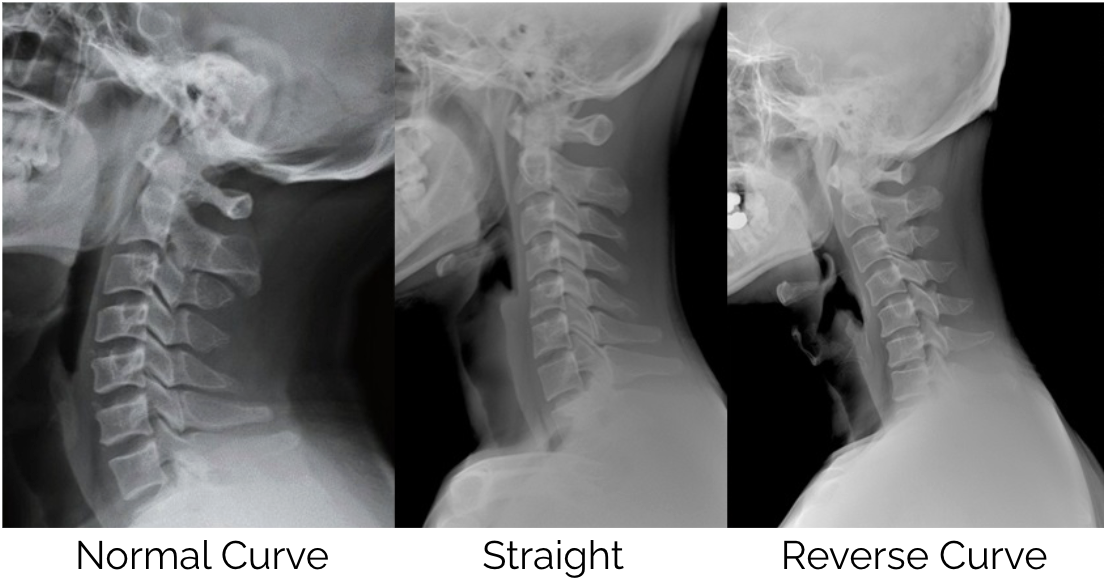
The cervical spine's relationship with the nervous system is particularly important here. The nerves exiting the neck supply the arms, hands, and parts of the chest and upper back. When the joints and soft tissues of the cervical spine are under prolonged load or restricted in their movement, this can affect how signals travel through the nervous system. This contributes to symptoms that patients often don't immediately connect to their posture, such as headaches, arm fatigue or difficulty concentrating.
A 2020 study (2) found that people with forward head posture showed significantly higher muscle activity in the muscles that run along the back of the neck compared to those with normal head position. In some cases, muscle activity was up to 87% higher, meaning the neck muscles are working far harder than they should during everyday tasks.
Who is most affected?
Tech neck is no longer just an adult problem. Children and teenagers are now among the most affected groups, with forward head posture developing earlier in each generation due to increased screen exposure from a young age. For adults, desk-based work, particularly with laptops, which tend to encourage a hunched position, is a major contributing factor. Trades workers and others who spend long periods looking down or working in fixed positions are also at risk.
Five practical steps to reduce tech neck
Raise your screen to eye level. Your monitor or laptop screen should be positioned so that your gaze is roughly horizontal. An external monitor or laptop stand makes a significant difference for regular desk workers.
Take movement breaks. The spine is designed to move. Aim to stand, walk or change position every 30–45 minutes. Even a brief reset can reduce the cumulative load on the neck and upper back.
Try the "balloon" technique. Rather than pulling the shoulders back (which rarely changes head position), imagine a string attached to the top of your head gently lifting you taller. As you lengthen upward, your head will naturally come back over your shoulders.
Check your phone position. Rather than looking down at your phone, bring the device up to eye level. Small habit changes like this, applied consistently, reduce the daily load on the cervical spine considerably.
Get your spine assessed. Many people are unaware of how their posture has shifted over time. A chiropractic assessment can identify where you have spinal tension, how your body is adapting, and create a plan to improve your posture and spinal health.
If you've been noticing tension in your neck, headaches or stiffness across the upper back, it may be worth having a conversation with us at your next visit. Tech neck tends to develop gradually — which means it often responds well when it's addressed before it becomes a bigger issue.
Reference
1- Hansraj, K.K. (2014). Assessment of stresses in the cervical spine caused by posture and position of the head. Surgical Technology International, 25, 277–279. PMID: 25393825.
2- Miclaus, R., Roman, N., Caloian, S., Mitoiu, B., Suciu, O., Onofrei, R.R., Pavel, E., & Neculau, A. (2020). The impact of forward head posture on the electromyographic activity of the spinal muscles. Journal of Taibah University Medical Sciences, 16(2), 239–245.